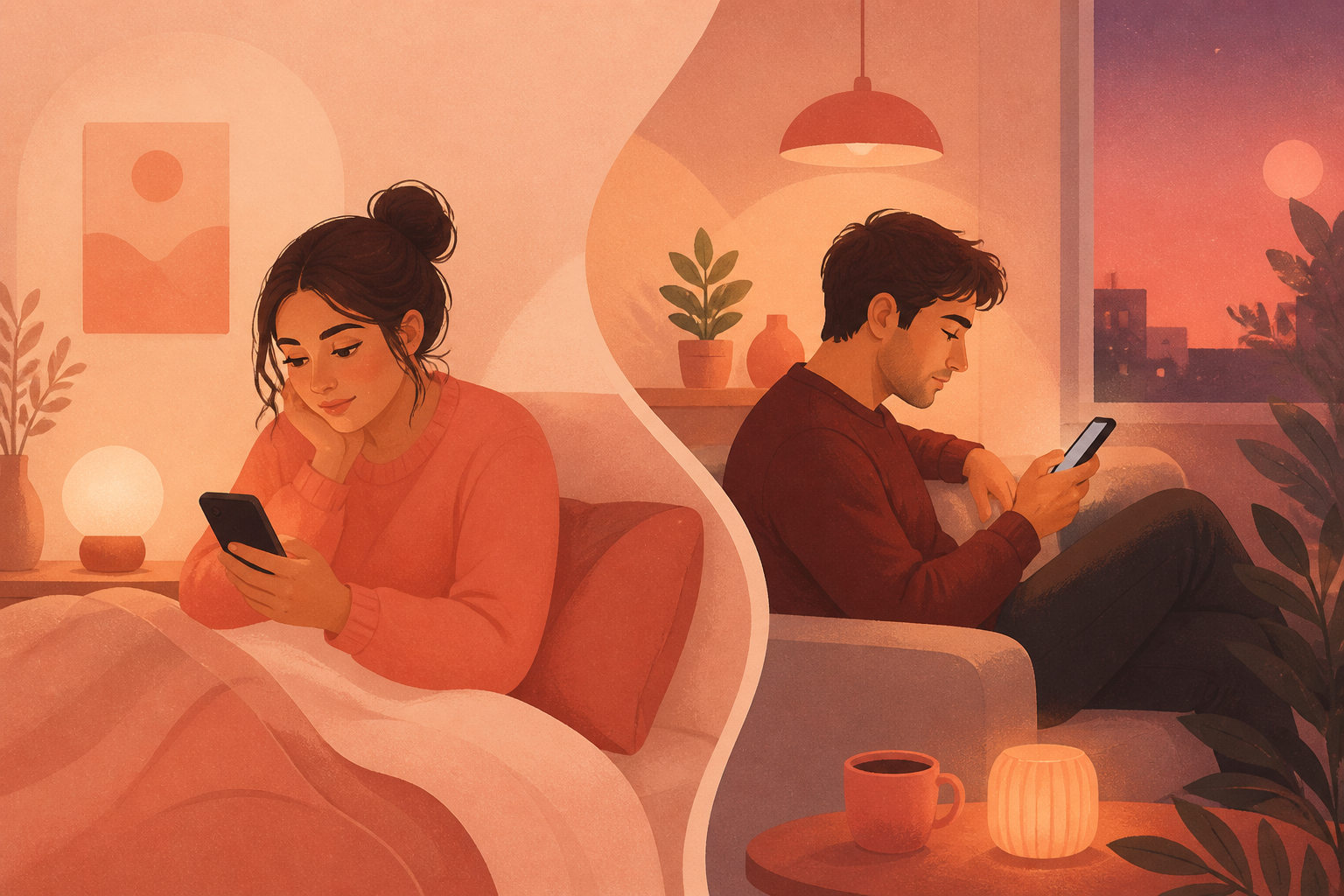
Texting Frequency in Relationships — Why Slow Replies Hurt
When a reply doesn’t come for a while, your mind spins: “Busy? Mad? Are they losing interest…?” If a single text can swing your whole day, this one’s for you.
Bottom line: a slow reply most likely doesn’t mean they don’t like you. Texting frequency comes from attachment style far more than from the size of someone’s love.
Texting frequency is about ‘attachment style,’ not ‘love’
In his book Attached, psychiatrist Amir Levine explains that a couple’s contact-and-distance patterns split sharply by attachment style.
- Anxious types need frequent contact to feel secure. Sparse texting spikes their anxiety.
- Avoidant types need space to feel comfortable. Too-frequent texting feels like pressure.
So when one feels hurt — “why don’t you text?” — the other feels pressured — “why so often?” Neither is wrong; they just feel connection differently.
A mini case
A year into dating, Mina always felt hurt by her partner’s slow replies. She’d tell herself “they’re busy,” then end up sending several messages in a row — which made him feel pressured and reply even later. A vicious cycle.
Turns out she was anxious, he was avoidant. Once she saw the rhythm was “different,” not “wrong,” she swapped interrogation for a need: “I’d like one check-in a day.” The fights dropped fast.
Self-check ✔
- ✔ Do you jump to negative scenarios when a reply is late?
- ✔ Do you fire off several messages when there’s no answer?
- ✔ Or, has frequent texting ever felt suffocating to you?
First two — likely anxious. Last one — likely avoidant.
❌ This pushes you apart
- Interrogating: “why didn’t you text?” → they get defensive and slower
- Rapid-fire messages + read-receipt checking (anxious “protest behavior”) → more tension
- Measuring love by frequency → stacked misunderstandings
✅ Do this — negotiate your texting rhythm
- Speak needs, not blame “Why don’t you text” ❌ → “One check-in a day helps me feel secure” ✅
- Agree on a minimum (a texting rule) Like “a morning hello + a goodnight text” — a line you both can keep. The anxious one feels safe; the avoidant one can predict it and breathe.
- Flag delays in advance “Lots of meetings today, I might be slow” prevents a hundred misreads.
The goal isn’t “more often” — it’s finding a rhythm that fits you both.
Find your attachment style, free
📱 If texting frequency keeps shaking you, start by knowing your attachment style.
Take the free attachment-style test on Bondi in 1 minute. Based on your result, an AI coach shows you “the contact style that fits you, and how to sync with your partner.”
Closing
Reply speed isn’t a thermometer for love. When texting frequency clashes, before suspecting your partner, try this: “We just feel connection in different ways.” The moment frequency becomes something you can negotiate, the hurt fades fast.