My Chest Tightens on the Way to Work — Protecting Yourself From Boss Stress
The heaviness starts Sunday night. Your chest tightens on the morning commute, and just seeing your boss’s name on your phone makes your heart drop. “Can I make it through this week?” — if you’ve already searched “how to quit,” keep reading.
Sound familiar?
First, hear this: you’re not weak. Humans feel the most stress in relationships where they’re being evaluated. Your boss holds your livelihood, reputation, and daily mood — tension there is completely normal.
Aaron Beck, the father of cognitive therapy (CBT), taught that what torments us isn’t the event itself but our automatic thoughts — the split-second interpretations we attach to it. The same comment can wound deeply or bounce off, depending on the interpretation that follows.
A case: “One comment used to ruin my whole day”
J, 31, came apart every time her boss gave feedback. “Redo this section” would trigger an automatic replay: I got scolded → he thinks I’m incompetent → I’m not cut out for this job.
Then she started keeping records and noticed something. Her boss said the same things to everyone, and what she’d actually heard was a single work instruction: “redo.” Everything else was interpretation her mind had added. As she put it: “80% of my stress wasn’t coming from my boss. It was coming from my interpretation.”
Boss-stress self-check ✅
If three or more apply, it’s time for the antidotes below.
- ☐ Your chest tightens on Sunday nights or the morning commute
- ☐ A message or call notification from your boss makes your heart drop
- ☐ Feedback sends you straight to “I’m incompetent”
- ☐ You replay conversations with your boss after work and on weekends
- ☐ Your boss’s mood decides your day’s mood
- ☐ Your appetite or sleep has noticeably changed
Why it hurts this much
1. It’s an evaluating relationship Your brain processes social-evaluation threat much like physical threat. A racing heart at one notification means your brain is working exactly as designed.
2. Automatic thoughts double the damage “I got criticized” happens once — but “I’m incompetent,” “I’m marked,” “I might get fired” beat you up all day. As Beck showed, the second arrow is the one you shoot yourself.
3. You’re trying to control the uncontrollable Your boss’s personality, tone, and moods aren’t yours to change. Helplessness grows when we try to change what we can’t.
Four ways to protect yourself
Antidote 1: Separate fact from interpretation (the heart of CBT)
- ❌ “I got scolded again. I must be incompetent.” (fact and story tangled)
- ✅ Draw two columns — Fact: “I was asked to revise page 2.” / Interpretation: “He hates me. I’m incompetent.”
- On paper, the interpretation reveals itself as an evidence-free guess. Half the damage dissolves right there.
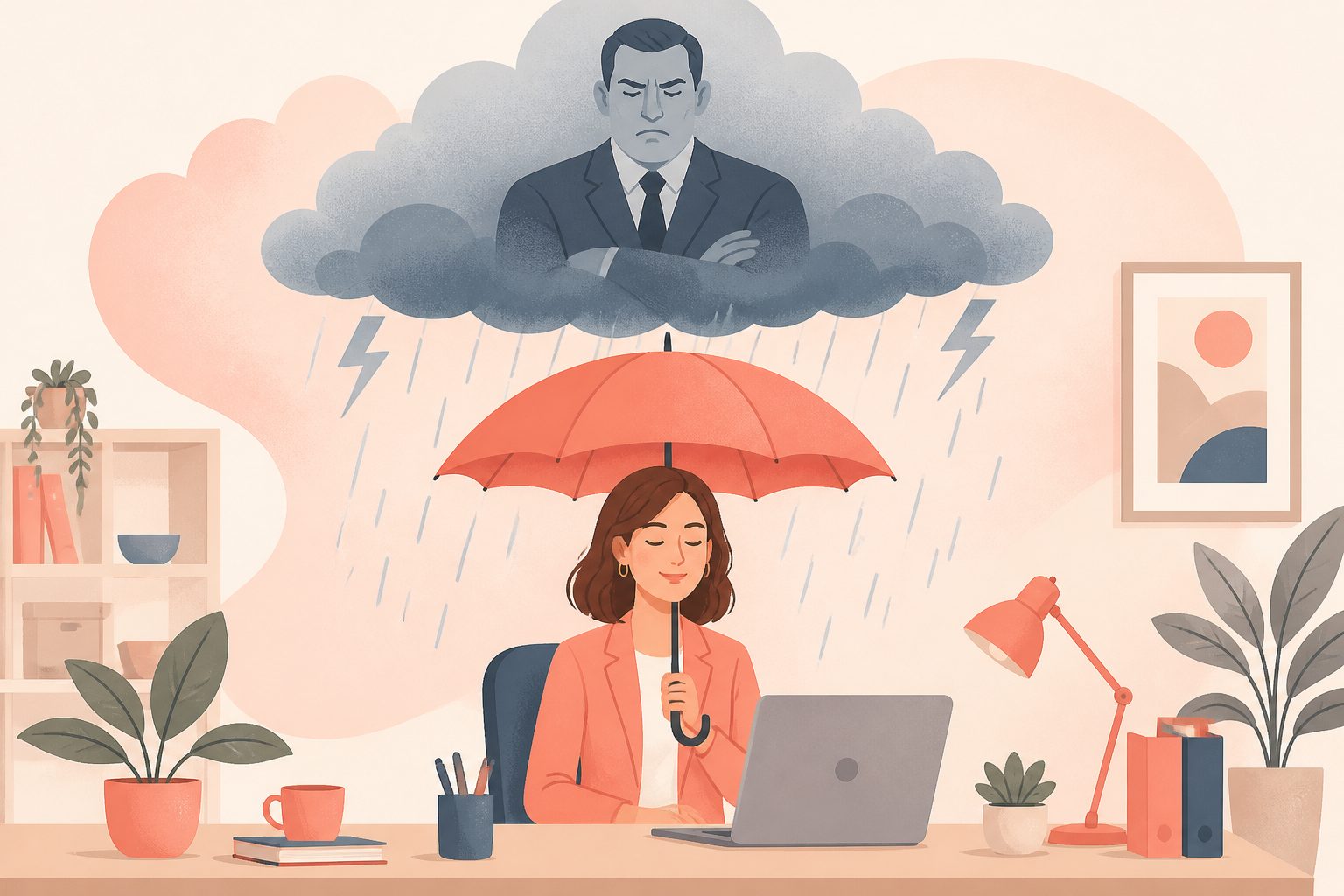
Antidote 2: Treat your boss like weather You can’t change the rain, so you carry an umbrella. Your boss’s moods are weather. Let the tone pass through; write down only the task. “Storm clouds today” — that one line of distance is surprisingly powerful.
Antidote 3: Build an after-work reset ritual Before leaving, jot tomorrow’s three to-dos (a “closure” signal for your brain) → same song on the commute home → a shower or a ten-minute walk. Repeat the same sequence and your brain learns it as the off switch. When work thoughts intrude: “That belongs to 9 a.m. tomorrow’s me.”
Antidote 4: If a line is crossed, document it Fair feedback and harassment are different things. If insults, outbursts, or public humiliation repeat, record dates, words, and context. That’s not an interpretation problem — it’s a situation that requires action, and records protect you.
The twist: The goal isn’t to like your boss. It’s to stop your boss from owning your day. They may sign off on your salary — they don’t get to sign off on your mood.
FAQ
Q. Should I quit right away because of my boss? Peak-emotion decisions become regrets. Separate “boss problem” from “job problem,” keep records, and observe for a month or two. If it’s abuse-level, document and protect yourself actively.
Q. It feels like my boss singles me out. Am I too sensitive? Compare the feedback colleagues get and collect facts. If the pattern is real, it’s not sensitivity — it’s your boss’s problem, and it warrants records, a conversation, or HR.
Q. I can’t stop thinking about work after hours. The brain clings to unfinished tasks (Zeigarnik effect). Declare closure with three written to-dos, then repeat a consistent reset ritual until your brain learns the off switch.
In closing
Your boss will still be there tomorrow morning. But the same words can hurt less — starting the moment you separate fact from interpretation.
Don’t chew on today’s stress alone. Talk it through with Bondi — it helps you sort the situation and spot your automatic-thought patterns. Your evenings don’t belong to the company.